Antibodies
Antibodies
_ Myasthenia gravis., _ Goodpasture syndrome., _ SLE., _ Limited scleroderma (CREST syndrome)., _ Pemphigus vulgaris., _ Type 1 diabetes mellitus., _ Bullous pemphigoid., [](Anti-histidyl tRNA synthetase (eg, anti-Jo-1), anti-SRP, antihelicase (anti-Mi-2)) Polymyositis, dermatomyositis., [](Antimicrosomal, antithyroglobulin, anti-thyroid peroxidase) Hashimoto thyroiditis., _ 1° biliary cirrhosis., _ Pernicious anemia., _ 1° membranous nephropathy., _ Scleroderma (diffuse)., _ Autoimmune hepatitis type 1., [](Anti-SSA, anti-SSB (anti-Ro, anti-La)) Sjögren syndrome., [](Anti-TSH receptor) Graves disease., _ Lambert-Eaton myasthenic syndrome., _ Celiac disease., _ Microscopic polyangiitis, eosinophilic granulomatosis with polyangiitis (Churg-Strauss syndrome), ulcerative colitis., _ Granulomatosis with polyangiitis (Wegener)., [](Rheumatoid factor (IgM antibody against IgG Fc region), anti-CCP (more specific))Rheumatoid arthritis., [](Antinuclear (ANA)) Nonspecific screening antibody, often associated with SLE., _ Drug-induced lupus., [_](Anti-U1 RNP (ribonucleoprotein)) Mixed connective tissue disease.,
Chromosome Disorders
_von Hippel-Lindau disease, renal cell carcinoma., _ADPKD (PKD2), achondroplasia, Huntington disease., _Cri-du-chat syndrome, familial adenomatous polyposis., _Hemochromatosis (HFE)., _Williams syndrome, cystic brosis., _Friedreich ataxia., _Wilms tumor, β-globin gene defects (eg, sickle cell disease, β-thalassemia,MEN1)., _Patau syndrome, Wilson disease, retinoblastoma (RB1), BRCA2., _Prader-Willi syndrome, Angelman syndrome, Marfan syndrome., _ADPKD (PKD1), α-globin gene defects (eg, α-thalassemia)., _Neuro bromatosis type 1, BRCA1, p53., _Edwards syndrome., _Down syndrome., _Neuro bromatosis type 2, DiGeorge syndrome (22q11)., _Fragile X syndrome, X-linked agammaglobulinemia, Klinefelter syndrome (XXY).,
Vitamins
_Biotin.,
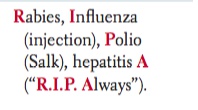
Vaccines
_..

_..
Recombinant Cytokines
_ (G-CSF) Recovery of bone marrow and WBC counts bygranulocyte stimulation.,
_ (GM-CSF) Recovery of bone marrow and WBC counts bygranulocyte and monocyte stimulation.,
_ thrombopoietin analog.,
_thrombopoietin receptor agonist.,
_IL-11.,
_CD25, Multiple sclerosis treatment.,
_Complement C5, PNH.,
_a4-integrin, MS/Crohn.,
_IL12, 23. Psoriasis.,
Repro drugs
_GnRH analog.,
_Estrogen antagonist at breast, agonist at bone/uterus.,
_Estrogen antagonist at breast, uterus. Agonist at bone.,
_aromatase inhibitors, used for ER positive breast cancer.,
_synthetic androgen, partial agonist at androgen receptors. Inhibit FSH and LH production by the anterior pituitary (negative feedback). It is FDA-approved to treat women with endometriosis-related pain; however, it is rarely used due to its adverse effects (hirsutism, acne, hepatotoxicity, etc.).,
_androgen receptor competitive inhibitor. Used for prostate cancer.,
Last updated